
Sources:
- Lexington MA Annual Budgets
- FY2025 Budget Presentation
- FY2025 Budget & Financing Recommendation
- FY2024 Budget & Financing Plan Recommendation
- FY2023 Budget & Financing Plan Recommendation
- FY2022 Budget & Financing Plan Recommendation
- FY2021 Budget & Financing Plan Recommendation
Lexington’s Fiscal Year
Lexington’s fiscal year begins on July 1st and ends on June 30th of the following year. Every year, the Town manager recommends a budget for the town, town government, and schools that covers the next fiscal year.
To learn more about the budgeting process, click this link.
Budget Summary
Revenue:
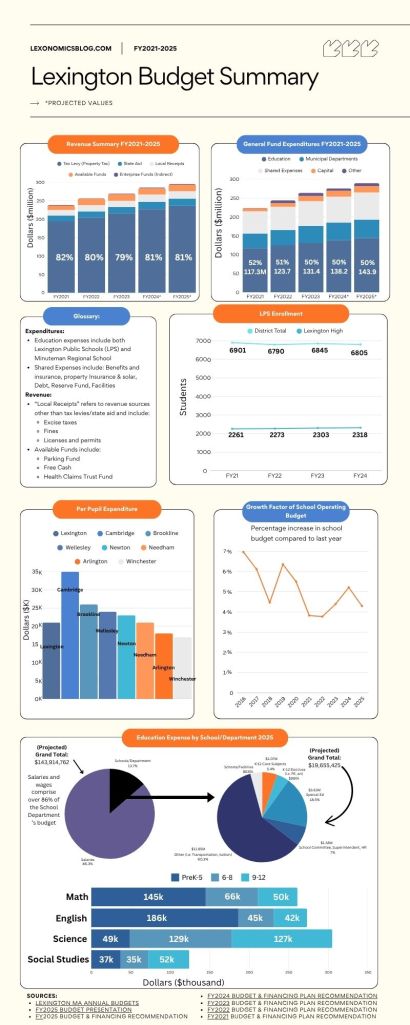
For the past 5 years, about 80% of the Town’s revenue has come from property taxes.
The rest of the revenue mostly comes state aid, local receipts (revenue sources other than tax levies or state aid; i.e. excise taxes, licenses, permits, etc), and other available funds (includes a parking fund and a health claims trust fund).
Expenditures:
Lexington spends half of its total general expenditures on education.
The second largest expense is “shared expenses,” which include benefits and insurance, property insurance, debt, reserve fund (essentially the Town’s “emergency savings”), and other facilities.
The Town also spends money to fund municipal (town/government) departments and pay for cash capital (tax revenue used to pay for projects all within the same fiscal year as the tax).
Lexington is projected to spend $290 million on total general expenditures.
Lexington Public Schools (LPS) Enrollment:
While the total LPS enrollment has stayed steady around 6,800 students total, the Lexington High School enrollment has slowly increased over time.
Education Expenses by School/Department (Projected – 2025)
Lexington is projected to spend about $144 million on education in 2025, with 86% of that spending going toward employee salaries.
Over half of the money not spent on salaries is spent on transportation, tuition, and similar expenses.
K-12 education allocates the most money for the science department, though the elementary schools spend the most money on English.


 Lexonomics Blog
Leave a reply to Alan V Seferian Cancel reply